
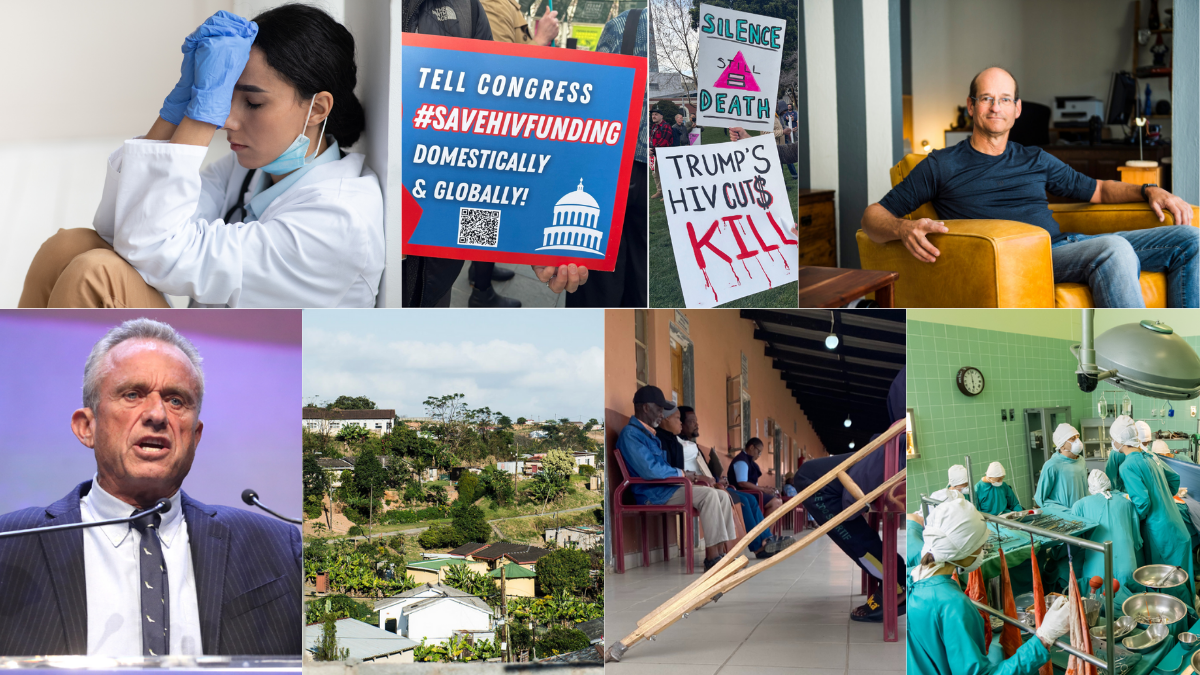
- With HIV funding cuts and the roll-out of lenacapavir, the new six-monthly anti-HIV injection, dominating much of our coverage in 2025, we wanted to make sure you didn’t miss some of our favourite essays and longreads of the year.
- These stories aren’t the ones that always make the headlines, but they often take us deeper into the people and places on the frontlines of public health in South Africa.
- Follow our journey into universities, hospitals, clinics and communities, with an unavoidable dose of the impact of the Trump administration on South Africa’s healthcare system.
In today’s newsletter, Tanya Pampalone introduces our favourite essays and longform stories from 2025 on public health in South Africa. Sign up for our newsletter today.

It wasn’t just the Trump administration’s assault on HIV funding and research, the tobacco industry’s influence machine, our obesity crisis or the mad scramble to get you the latest on the new six-monthly anti-HIV injection that kept us up at night in 2025.
There was the story about a professor that drinks tequila with rock stars and an essay that stopped a finance minister mid-speech. The 1934 generator that still keeps a hospital alive. That one night in the rural health clinic. The sliver of land called Magelekedeni, where mental health scars run deeper than the flood damage. And that time we went to San Francisco, where an HIV activist raised a poster he thought he’d retired decades ago.
We wanted to make sure you didn’t miss some of our favourite essays and longreads of the year.
These stories aren’t the ones that always make the headlines (although, read why Sarah Stein’s essay on What they don’t teach in medical school made it into Finance Minister Enoch Godongwana’s 2025 budget speech!), they often take us deeper into the people and places on the frontlines of public health in South Africa.
Follow our journey into hospitals and clinics with a behind-the-scenes tour of Groote Schuur and the tale of a rural clinic in KwaZulu-Natal, and into one community where we witnessed some of the mental health fallout of the 2022 Durban floods. And then go back to class with the complicated realities of medical school and a profile of Wits Professor screw it, let’s do it.
The far reach of the Trump administration — including the impact of funding cuts and the fallout of the vaccine mis and disinformation peddler and US health czar — landed up on our editors’ picks, too. But those two longreads manage to help the bad news go down a little easier.
Enjoy the reads!

What they don’t teach in medical school
Sarah Stein is a doctor-in-training whose essay wonders aloud about what she was actually doing in medical school. Being a constant witness to death and dying was a part of the job she can’t get her head around. But it was her description of what was happening in our public hospitals that landed her piece in Finance Minister Enoch Godongwana’s 2025 budget speech.
“The situation this young doctor describes, of the state of our public hospitals, and the emotional toll of working day after day without the basic resources necessary to help people in need, is the heartbreaking reality that this budget hopes to address,” he told the nation before reading an excerpt from her letter.

A frightening glimpse into the future of HIV research under Trump
As the pain of the HIV funding cuts was hitting South Africa, Mia Malan travelled to San Francisco, where she met longtime HIV activist Mark Harrington outside of the prestigious 32nd Conference on Retroviruses and Opportunistic Infections, Croi. The gathering, which has been the platform for groundbreaking HIV science since 1993, was notable for who wasn’t there — those working for the largest US government health agencies.
By then, the Trump administration had laid off hundreds of staff and declared words like bias, equitable and sexual preferences off limits. Harrington led a rally surrounded by posters with decades-old slogans like “silence = death” and doing something he thought he’d never have to do again: fight for the US government to recognise HIV and fund the research that’s needed to combat it.

Professor screw it, let’s do it
Sean Christie’s monthly profiles of public health heroes, including former deputy director general of health Yogan Pillay to Doctors Without Borders’s Candice Andisiwe Sehoma, made it difficult to choose just one.
But this romping portrait about Francois Venter — the professor you wish you had in university — is delectable. Sean takes us from Venter’s childhood in apartheid-era Phalaborwa, Limpopo, to a career that began at the height of the Aids crisis and eventually landed him at Wits. Spoiler alert: it includes the details from his unorthodox inaugural full professorship lecture in 2023, which included shout-outs to his rock climbing coach and that time he drank tequila with Dexter Holland of the rock band The Offspring.

Making diphtheria great again? Why SA’s public health experts are worried about RFK Jr
After US health czar Robert Kennedy Jr, known as RFK, accused the international vaccine alliance of distributing a harmful version of DTP — the diphtheria, tetanus and pertussis (whooping cough) vaccine — Ida Jooste and Tanya Pampalone dived into the mis and disinformation campaign, which is spreading across virtual and physical borders, ignoring decades of science, worrying South African public health experts.
“Where the state now becomes the source of the disinformation, you lose your bearings as to where to get the truth,” Salim Abdool Karim, director of the Centre for the Aids Programme of Research in South Africa, Caprisa, told Bhekisisa. “That’s why the right information about vaccines is as important as the vaccines themselves.”

The falling down place
On a sliver of land in Inanda, where tiny yellow sunflowers dot lush green hills, houses are perched on steep drops that look onto the valley below. The locals call the place Magelekedeni. In isiZulu, that means landslide. Which means it was not where you wanted to be when the April 2022 floods slammed into KwaZulu-Natal.
The disaster left its mark not just on the land and the collapsed homes, but on devastated lives and the mental health of people living there. Tanya Pampalone and photographer Delwyn Verasamy visited Magelekedeni to talk to its residents about what happened during and after the storm.
It is the first story in a series about the impact of climate change on mental health in communities in South Africa, Kenya, Burkina Faso and Mozambique, which is part of a Wellcome Trust-funded project with the Africa Health Research Institute.

Three mental health breakdowns. One rural clinic. And a lesson in ubuntu in a time of scarce resources
Indira Govender’s essay is about one night in a rural clinic in northern KwaZulu-Natal, when she witnessed three people breaking down mentally, during her weekly shift as the clinic doctor. Clinic guidelines instructed that an ambulance should have taken the patients to hospital, but there were none available.
In this expertly crafted story, everything could go wrong, but somehow turns out just right. As she writes of the “understated and unmeasured collective strength” in rural healthcare as well as the community itself, “there is inspiration and hope among characters and relationships defined by ubuntu that transcend guidelines, uniforms or social status”.

Anatomy of a hospital: Groote Schuur in a time of budget and staffing cuts
When Sean Christie went to interview Groote Schuur’s Shaheem de Vries for his monthly profile series, the CEO instead offered up the hospital and the staff on the front and backlines of patient care.
With Sean and photographer Jay Caboz as our guides, we travel through the hospital’s bowels, where a 1934 generator still powers the boiler system, to Theatre Street, where state-of-the-art surgery is performed with world-class technology.
Along the way, we meet a stream of characters, including porter Sibusiso Sonjica, who switches to tsotsi-taal to calm panicking gunshot victims and manager Belinda Jacobs, who admits she can’t always give patients what they need. As De Vries tells us: “If you want to work in public healthcare in South Africa, it helps to get comfortable with ambiguity.”

Tanya Pampalone is Bhekisisa's senior editor. Pampalone is the former managing editor of the Global Investigative Journalism Network and former executive editor of the Mail & Guardian.


